Human Connection and Longing for Hope: Reflections from the World Beautiful Business Forum
When winter is on the doorstep, some birds fly south to find warmth and nutrition. Like these birds, more than 1,000 people from all over the world made their way to Athens one week in early May to escape their usual day-to-day worklife and experience some human connection and warmth while getting their own thinking challenged...
And I was one of them.
The World Beautiful Business Forum run by the House of Beautiful Business stretched across three days, plus some side events the day before and after. And as the organizers put it in the attendee updates a few days before the event, the program they created was a monster!
They ran ten different tracks in more than five venues, touching on topics from Beauty and Longevity to Democracy (an obvious one in Athens) and Agentic Worlds.
The sessions covered questions like:
How to live a good life?
How to lead consciously when everyone—including the very planet we live on—seems to be in survival mode?
What implications will it have on society when more and more people live healthier and longer lives?
Will the future be more extractive (because AI is extracting from us) and do we therefore need to focus more on replenishment and rest?
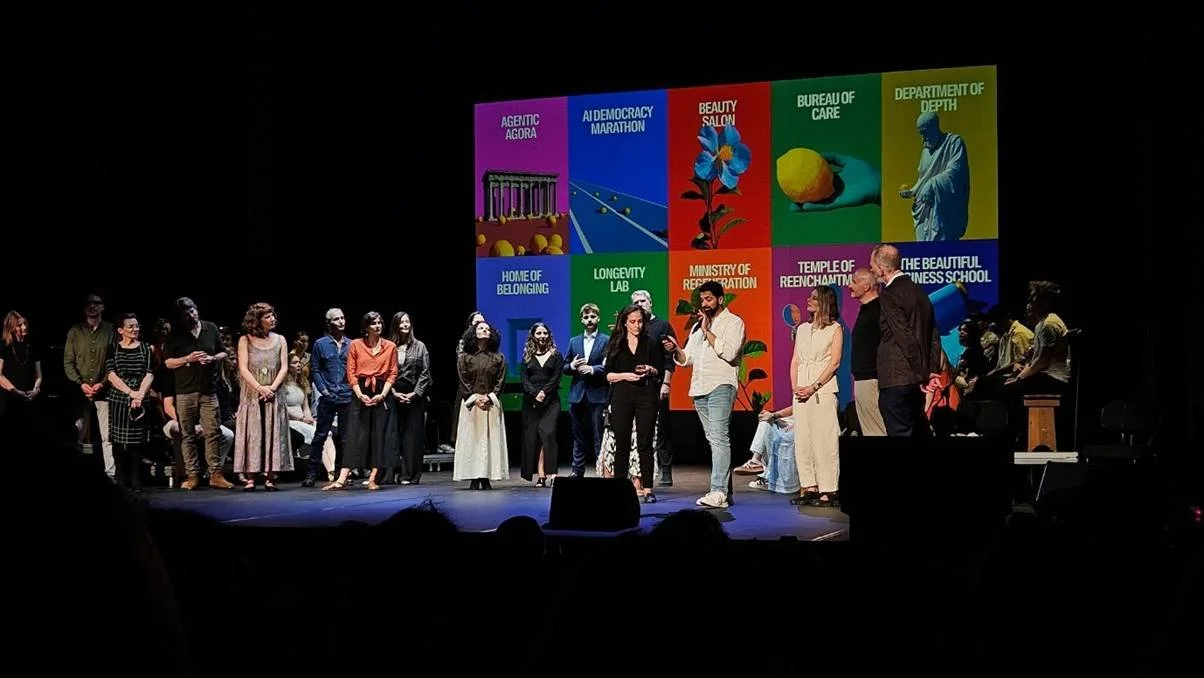
All track curators on stage for the final day’s wrap-up.
These are only very few of the questions that arose from what happened on stages. Let me share a few more of my favorite moments.
A few standout moments
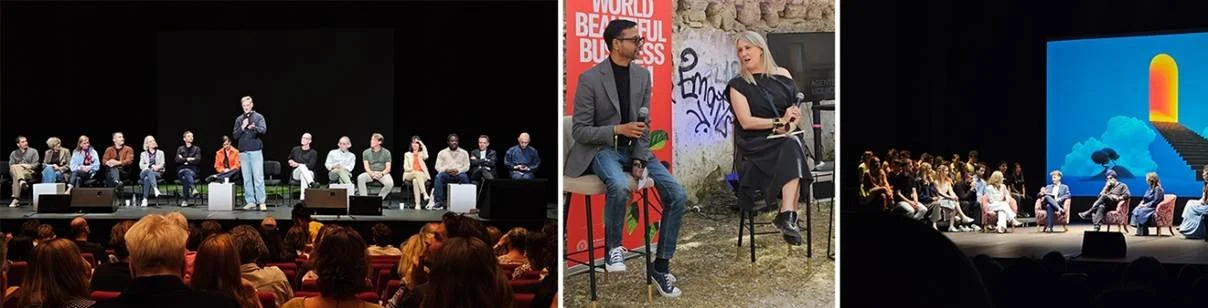
I watched 15 philosophers discuss the big questions of life with us sitting in very comfy opera seats in the auditorium of the Olympic Theater. Some of the questions and topics that resonated most with me included:
"Is it wrong to see a human as one entity if there are millions of bacteria living inside of us that have a scientifically proven impact on our mental health?"
They asked us to "pick one word to describe a most livable city" and sit with that word for a bit. (“Participation” was mine. What would yours be?)
And I heard that all we might really need is 'a butt and a chair,' springing from an observation that this is all elderly people seem to need to experience the good life while sitting in front of their houses with friends.
AI exhaustion and scapegoating
I watched psychologist Elaine Kasket and technologist Anol Bhattacharya discuss everything from what to write on their own tombstones to AI agency. This conversation reiterated some of my own observations about how humans seem overwhelmed with AI being their new colleague—it's very exhausting to constantly review what the machine created. Elaine shared how in her conversations with AI it has tried multiple times to attribute things to her that she never wrote, and Anol explained the context rot mechanics behind that observation. Anol also made an important point: We seem to have a tendency to blame AI for things it never did. (As in firing people. To be clear, people are firing people—even if AI may have created the list of whom to fire.)
Retraining our positivity muscles
Then Rachel Goslins moderated an inspiring panel with Indy Johar and Petros Apostolakis from the Youth Delegation. Rachel talked about us humans picking up positive stories and narratives slower than negative ones—and that we all should make sure to retrain our muscles there. We should actively and deliberately observe the world through a positive lens and push ourselves to spread the good news, the hopeful best-case scenarios and narratives.
Celebrating life to avoid hurting others
I also watched Bayo Akomolafe talking about colonialism and morality—and that we need to celebrate life being the sacred thing it is more than we do right now. Because "if you can't feel life, you will hurt life." He built that on a novel called The Ones Who Walk Away from Omelas that will make it onto my reading list, even though it sounded like a tough read.
Facing our fears about aging and mortality
Next I worked through questions like "What will my kids tell their grandchildren about me?" with Reeta Hafner and Martin Thörnkvist. The session was all about aging, our fears around it, and what it means to be mortal. The audience was discussing questions like "What makes me bitter if I think about my life?", "Where do I want to choose to protect heritage and culture?", "Am I drifting away from or towards my essence right now?"
Allowing ourselves to truly see each other
Then I sat in a room with strangers. All in pairs, facilitated by Esther Blázquez Blanco, where we practiced presence with a ten-minute eye-gazing experience. I found a lot of stillness and a very calm comfort in myself during the exercise, felt held, seen, and left with a strong inner picture from our conversation afterwards: What if observing the ocean is no longer enough to read its tides and currents well? I might have to look up and look at the moon from now on to observe the mass that is moving it all. (I’ll be forever grateful for this experience to João Sevilhano.)
Replacing the idea of utopia with “Protopia”
And I listened to Tim Leberecht and Till Grusche talking about "Protopia"—a future that is increasingly better than the current present. With this lens, 1% at a time is a model for constant improvements without the utopian pressure.
Enjoying the other star of the show: Athens
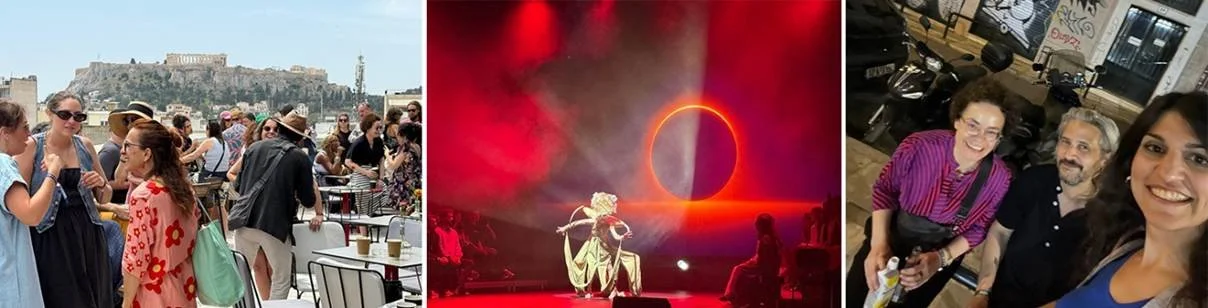
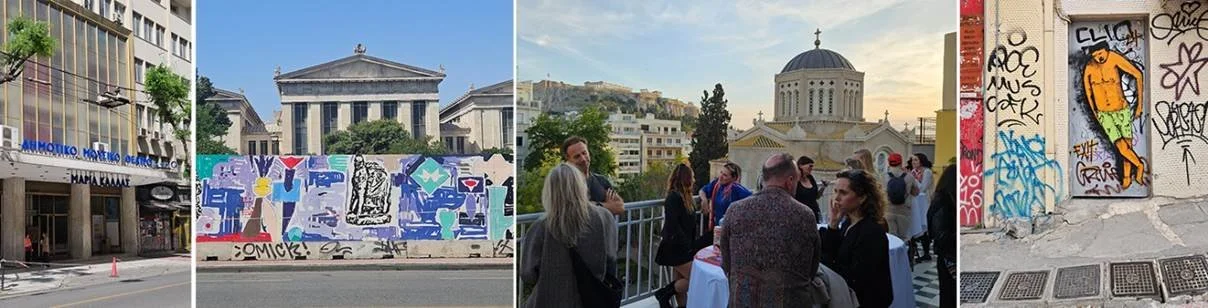
Beside the stage conversations, I enjoyed walking around Athens, where all venues were a 15- to 20-minute walk apart. That helped me explore and get a feel for the city—and it was a great chance to digest the content and discuss it with fellow attendees. One evening we toasted to "the monster" (a reference to the event’s programming) over Greek salad and mouth-watering melted cheese dishes that I'm still thinking about. While walking and talking over meals like that, I had at least a dozen very deep conversations with other attendees. These discussions brought up even bigger questions, like: "Did I only decide to come to this event to be convinced that my cynicism is no longer needed?"
Finding a red thread in all of that
A fellow attendee shared an observation that became the beginning of my red thread through the entire conference: It looked like everyone was on a quest for hope. Everyone seems to feel the massive burden that presumed AI-enhanced changes will force on us,so everyone came for the silver lining in a world of presumed poly-crisis. Maybe all of us came to regain or strengthen our hope in humanity—and in our capability to shape the agentic world to be safe instead of life-threatening. And, thankfully, we found plenty of that hope along the way.
I, for example, found hope in the fact that the societal impact of AI was discussed very broadly, from many angles, by people with very different backgrounds. And yet they all landed on similar themes.
There has not been one question, topic, or realization on that topic that hit me out of left field. Not a single thing I had never heard or thought about.
And that gives me tremendous hope.
Here’s why: From my product coaching experience I know that step 1 of solving for something is always to define a good research question. And it seems that we are settling in on those. There are research questions evolving and we are ready to scale the team to start the cross-disciplinary solution phase.
Other aspects of the event that gave me hope:
Bringing arts, science, and philosophy together in one room creates perspective that we otherwise would not have had. That's something we can all rely on.
When in community with others and psychological safety is present, humans are very generous with sharing their experiences, learnings, and viewpoints,which then allows everyone to build on each other's ideas.
Creating this space where people can safely connect and share is Tim, Till, and their team’s biggest achievement—and the reason why I returned to the House (after last year's event in Tangier).
It is rare and a massive privilege to be in rooms with people that explore today's challenges from a very meta perspective. And whenever I can, I want to be in these rooms,to get my own thinking challenged, to look at familiar challenges from new angles—and sometimes, just be inspired by a song or the beautifully crafted marble roads in Athens.
Pretty sure this was not my last HoBB event.
Here for the mosaic? Quotes from Athens
If you want to expose yourself to some of the quotes I collected, keep on reading. I know some of them might be hard to interpret without more context, but some might hit exactly the right tone for you at the right moment. So let serendipity win 🙂
"The opposite of art was never commerce or science. It's empire."
"If thinking is what makes us human, then we might have a problem."
"We are beginning to absorb the machine's vocabulary."
"Machines are becoming more like us. We are becoming more like machines."
"AI has never loved, it has never lived, it has never grieved."
"AI has no aura."
"You should doubt more! That is a very human quality."
"Only when you feel not quite right, only if you are having a bad day, you will ask a question like 'what is a good life?'"
"A good life is a quiet life."
"There is an abundance of chatter, of data, of noise..."
"Humans will need to explore new and different ways of being present."
"To feel life you have to have the dignity to matter."
"A good life is having meaningful encounters with other humans."
"How can I receive the goodness in life, the goodness of this moment?"
"How can we become better ancestors for the generations to come?"
"We should be listening to the voices that are already screaming at us!" (about equality in resource distribution)
"All AI slop is human slop. Because a human has decided to hit the publish button."
"A lot of what we train AI with is corporation slop. And it now pollutes the internet like we pollute the environment."
"We should not sacrifice our own human agency to AI by aiming for 'fully autonomous' agents. Let's stay in the loop."
"AI causes 'the epidemic of self-mistrust'. We have the tendency to double check every thought of ours."
"We might be in an abusive relationship with AI. In an abusive relationship the abusing part makes the other question themselves. That is part of their power and the abuse."
Folks to follow in case you want to diversify your LI feed
Elaine Kasket (You’ll have the chance to meet her in Hamburg at Product at Heart!)
And special thanks to all my conversation partners, just to name a few: