Building Your Leadership Support Team
I've had quite a few coaching conversations over the past few weeks with exhausted product leaders. December and January tend to be like that—people are wrapping up the year, looking ahead to the next one, and asking themselves: "How do I make 2026 less stressful than 2025?"
It's a good question. An important one.
Here's what I've noticed. The leaders who seem to have more headspace—the ones who aren't perpetually exhausted—have usually built some kind of support system around themselves. It's not that they figured out a secret. They just gave themselves permission to ask: "What would help me perform at my best?"
In this post, I want to share one idea that somehow doesn't come naturally for most product leaders. What if you could build a team around you that helps you offload some of the work so you can focus on the things only you can do?
Two Ways of Working
When I look at the product leaders I've worked with over the years, I notice two different patterns:
Some leaders understand that their time is valuable enough to the organization that it makes sense to create support functions around themselves.
Others seem to have never really paused to think about how they do their work. They often came from individual contributor positions as product managers, where success meant staying on top of everything. The winning mindset was: "I'm the PM. I need to know everything. I need to do everything."
And honestly, that approach made sense back then. It was not a bad instinct. But somewhere along the way, their role changed. They got promoted to a leadership role. And with that, they started leading an entire product organization.
If you make bad decisions under stress as a PM, that already has some ripple effects. But in a leadership role, the ripple effect of a bad decision can quickly become a company mini-tsunami. So the old playbook just doesn't scale.
This isn't about blame. It's about acknowledging where you are in your career, how many people you influence, and who you impact with the work you do. A stressed-out product leader who’s making harried decisions is probably not the example that you want to set. But once you see this pattern, you can choose to show up differently.
You're Closer to a Pro Athlete Than You Think
Here's a thought experiment: Think for a moment about a pro athlete, someone who’s achieved the top level of skill in their chosen field.
No professional athlete ever succeeds without a team of specialists around them. They have coaches refining their technique, nutritionists planning their meals, team assistants handling logistics, physical therapists preventing injuries, and mental performance coaches keeping them focused.
All of these people exist for one reason: so the athlete can perform at their best when it counts.
Now, let's be honest. If you're leading an entire product organization where you’re responsible for the people, strategy, and outcomes, you're much closer to a professional athlete than to the occasional January gym-goer who shows up once in a while and hopes for progress.
So why would you try to do it all alone?
To help illustrate this point, here’s a page from my personal playbook. People often assume “Petra Wille” is a one-woman company. It's not. I have a part-time EA, my part-time editor, a part-time social media person, a web developer I work with regularly, and a visual designer I bring in when needed. I have my own coach.
And because I know I need to stay grounded and healthy to do this work well, I've built a support network there, too—a gym membership, a nutrition coach, a therapist.
Plus, there are various communities I belong to. There’s one of around 40 people that do similar coaching work to what I do, the local product community in Hamburg, and of course close work-friends that I lean on for advice or when I need to talk through an idea.
None of this happened overnight. It started with one thing.
What Support Could Actually Look Like
I'm not saying you need a full entourage—or even a setup that looks like mine. But let me paint a picture.
What if you had an executive assistant who helped with your calendar, someone who handled scheduling conflicts and protected your deep thinking time? Every hour they saved you would be an hour you could spend on strategy, coaching your people, or properly preparing for that important 1:1.
What if you had a dedicated data analyst who pulled together supporting data for the strategy you're working on? Instead of spending hours in dashboards and spreadsheets, you could focus on the insights and decisions.
What if you had a coach—someone outside your organization who helped you see more clearly and stay focused on your personal goals? Someone who asked you the hard questions or who served as a sounding board for you to think things through with?
What if there was a vibrant community of product practice that handled some of the onboarding conversations, role definitions, and knowledge-sharing that might otherwise all land on your desk?
I know—this sounds unrealistic. And maybe it is. But let me make the case…
Making the Case for Growing Your Support Team
I know what you might be thinking. "That sounds great, but I'd have to make the case for it. I'd have to convince someone. I'd have to prove the ROI."
Yes, you would. And you should.
Because every hour you free up for deep thinking, working on strategy, or properly preparing for that employee 1:1 is an hour well spent—not just for you, but for your entire organization.
To put it in business terms, your time as a leader is quite expensive, and your company gets much more value when you are putting it towards impactful activities like developing your strategy and coaching your team. The time you spend on administrative tasks is actually costing your company.
I used this analogy in my first book, STRONG Product People: Imagine that you are the owner of a handmade soap business, where you produce an average of five bars of soap each day. You could carry along like that, but your business would never grow and your profits would remain stagnant.
But if you spent a little extra time hiring people to help you (and onboarding them properly so they could do the work you once did on your own), you could ultimately increase your output and transform from a single craftsperson into a growing soap bar empire.
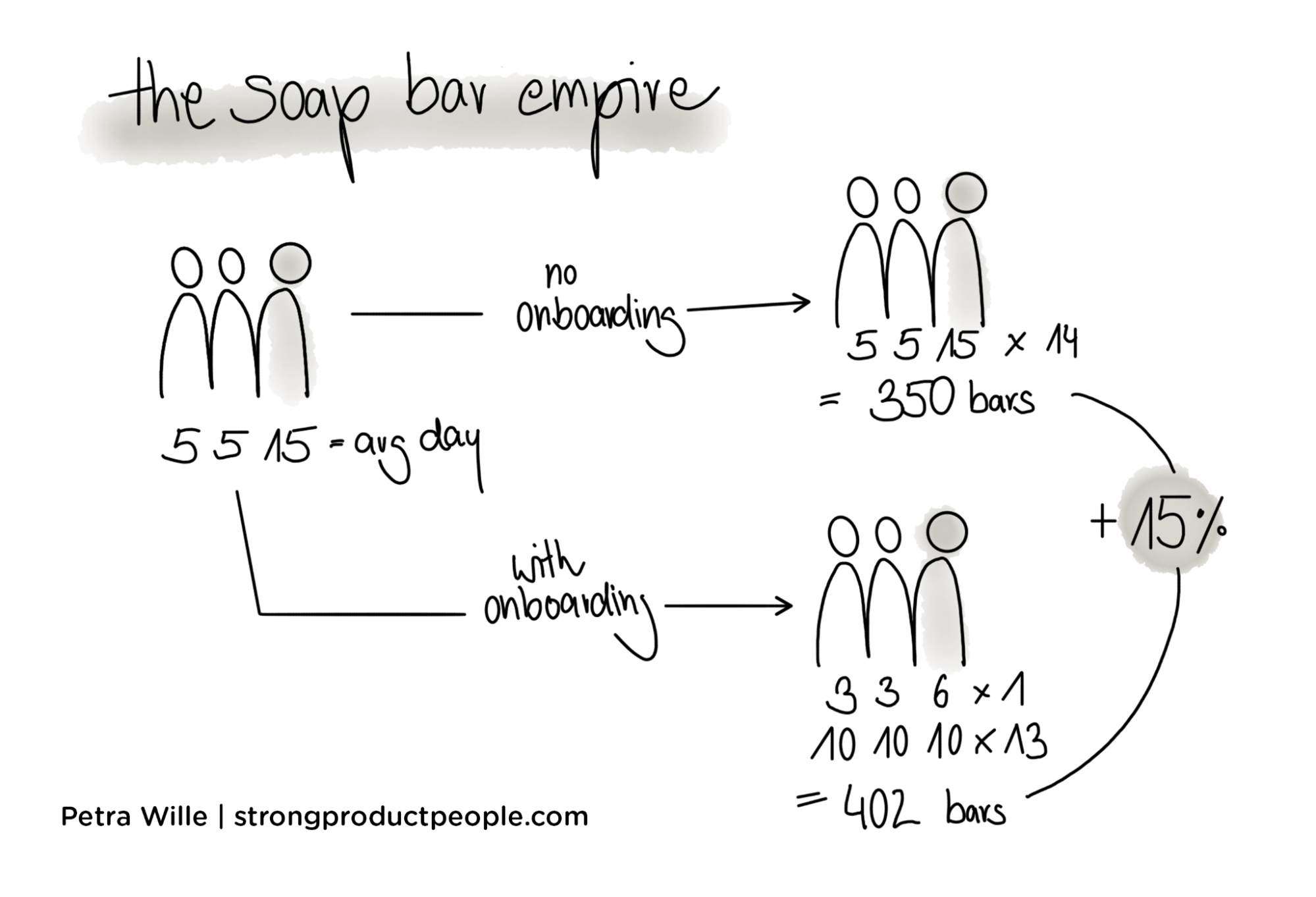
The soap bar empire is a useful analogy for seeing the impact good leadership can have on a company’s output. In other words, investing in yourself (and your team) will ultimately help your business.
You can make a similar argument for outsourcing some of the tasks that are stressing you out, whether it’s because they’re administrative, tedious, or simply not making the most of your talents. The amount of money you might spend would be trivial in comparison to the impact you’d be able to have if you’re feeling less stressed and more capable of working at your full capacity.
And here's the thing: You don't need to start with a full-time executive assistant. Maybe you could start with a part-time data analyst. Maybe you could invest in coaching for yourself. Maybe you could pilot a community of practice and see what happens.
Not everything has to be big or expensive. But not even looking into these possibilities? Not even allowing yourself to consider what support might look like?
That's not what a professional athlete would do. And that is not what a product leader should be doing, either.
A Small Step Forward
So here's what I'd suggest: Be intentional about this.
Take 15 minutes and list the things you could potentially hand off. Calendar management, data pulls, onboarding conversations, whatever comes to mind. Don't filter yet—just write it down.
Then find a peer or trusted colleague and talk through the list together. Where might help actually be possible? What would make the biggest difference?
And then: Start with one thing. Just one.
That's it. That's how it begins. Face the reality that you and your decisions do have a big impact on your org and make sure you are focusing on doing the most meaningful and valuable things.
If this resonated - my 52-week email course From STRONG to Exceptional covers this and 51 other product leadership topics, one week at a time. Have a look.