On helping write the Makers Manifesto
I'm still a massive fan of the Agile Manifesto. A small, sharp document that shaped how our whole industry works.
So when Faith Forster reached out and asked if I wanted to help create a manifesto for AI product working principles, my honest first reaction was hesitation. The Agile Manifesto set such a high bar. Was this even the right moment, with the field still in so much flux? Could we get the right people in the room? Would a big, collaborative group land on something meaningful enough to deserve the word "manifesto"?
I thought about it, and then I thought, "Screw it, let's see where this takes us." I knew I could opt out at any point if I wasn't happy with the result.
I didn't opt out. I'm happy with where we landed.
What we made
The Makers Manifesto is a set of core principles for making great products in an AI-driven world. It was put together by a global group of cross-disciplinary contributors - product managers, designers, engineers, founders, coaches - coordinated by Faith.
We chose the word "maker" on purpose. It's broader than "product manager." If you build software tools, apps, or agents, these principles are written for you too.
The shape will feel familiar if you know the Agile Manifesto: a short preamble, four value pairs, and a set of principles underneath them. The four values are:
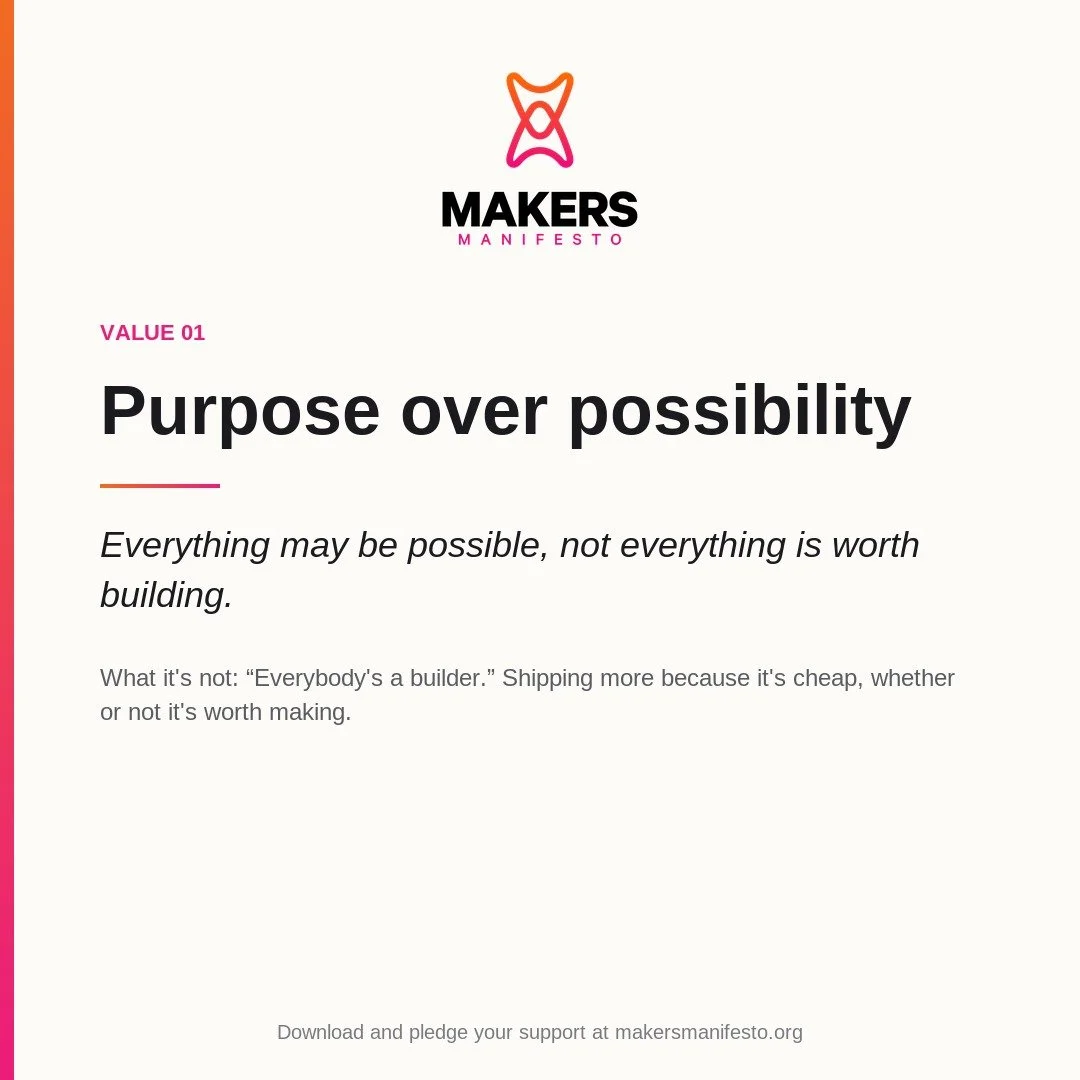
🧭 Purpose over possibility
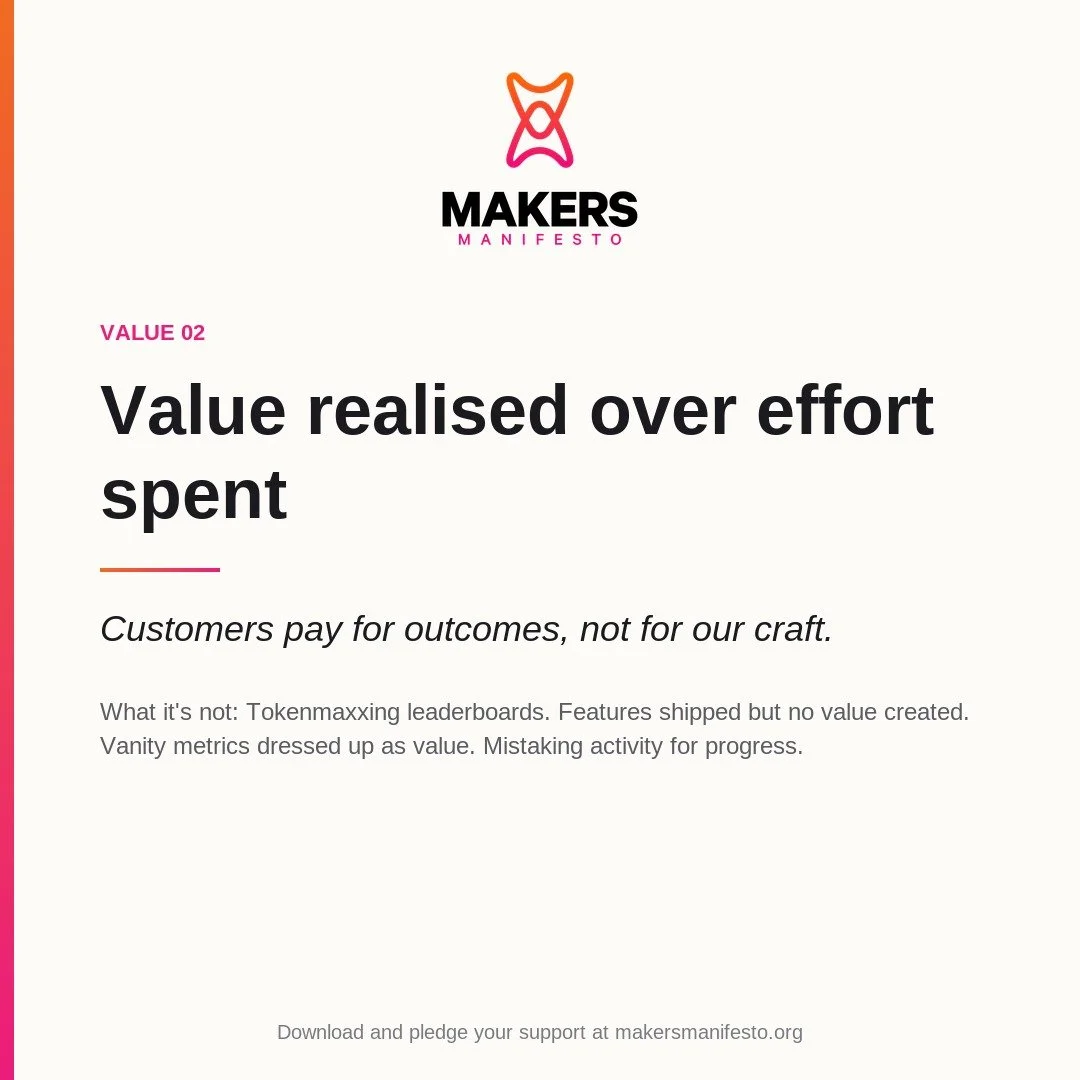
🔍 Value realized over effort spent
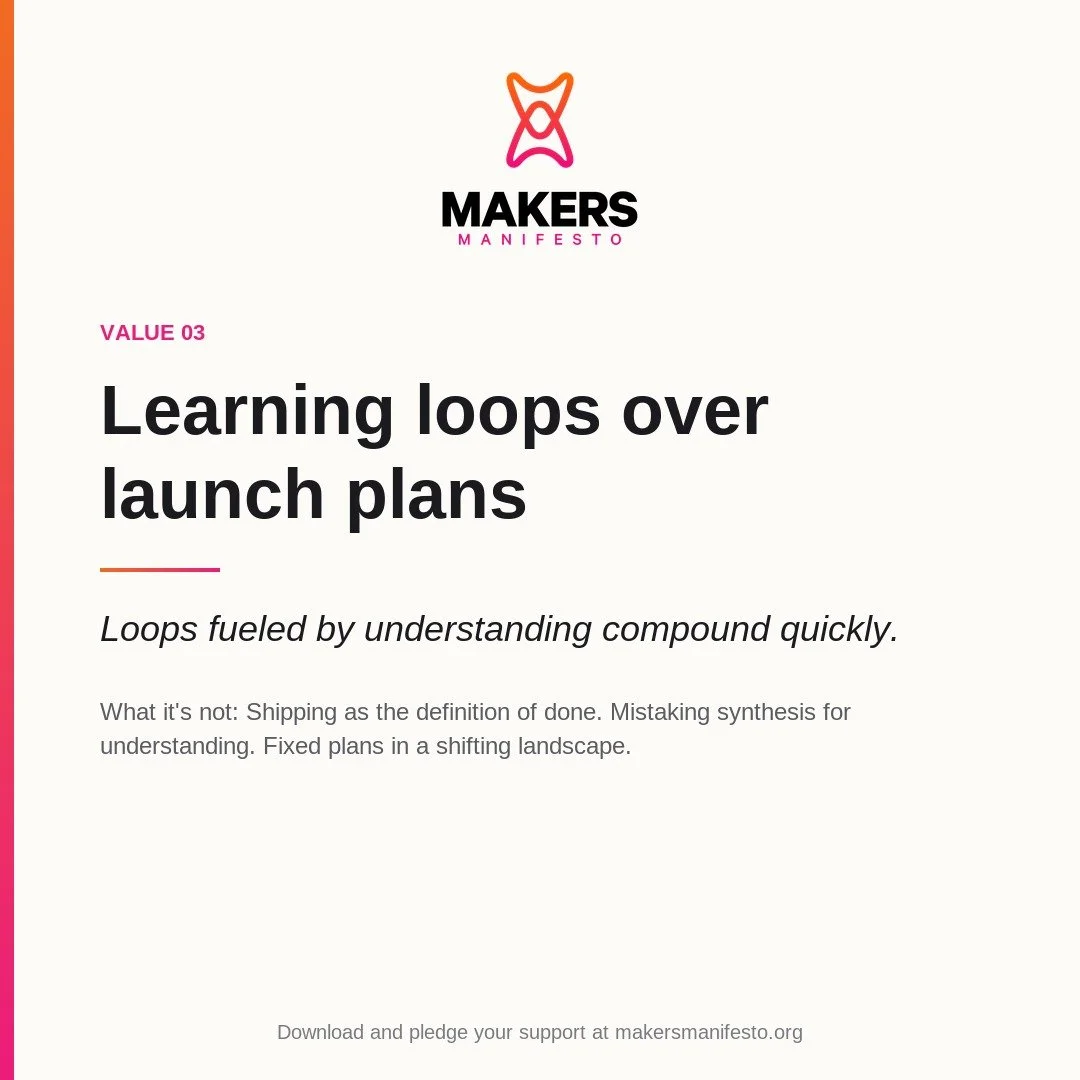
🔁 Learning loops over launch plans
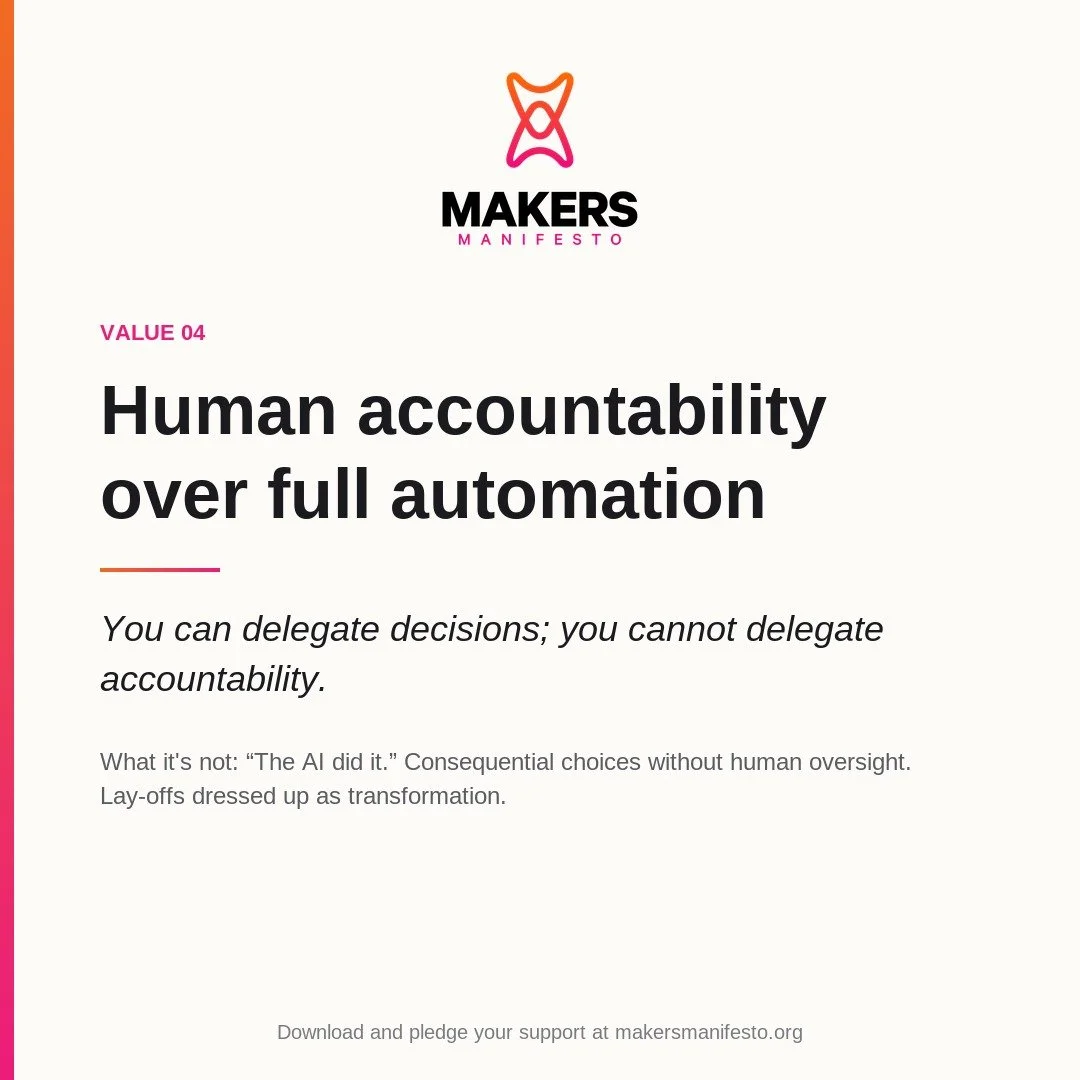
✍️ Human accountability over full automation
The parts I care about most
When I filled out the working group's survey back in April, a few themes kept surfacing. They're the same ones I see every week in my coaching work, and I'm glad they made it into the final document.
Purpose over possibility. AI makes building cheap, and that's exactly the trap. The moment teams get more capacity, most of them use it to ship more, not to understand more. No product ever needed more features. We need better ones. "Everything may be possible; not everything is worth building" might be my favorite line in the whole thing.
Value realized over effort spent. Customers pay for outcomes, not for our craft. It's easy to mistake activity for progress when your tooling lets you produce ten times as much.
Human accountability over full automation. You can delegate decisions. You can't delegate accountability. "The AI did it" won't be an acceptable answer, and the principle I quietly cheered for is the last one: humans sign the work. We stay answerable for the consequences, by design.
Underneath all of this sits something I've believed for a long time: every product decision is a curation decision. What we build, what we don't, what we choose to normalize. AI raises the speed and the stakes of those choices. It doesn't change the responsibility.
Where I've still got questions
I'll be honest, a document written by 40-something people is always a bit of a compromise. There are phrasings I'd sharpen and ideas I'd push further. But that's part of the design. The manifesto is a snapshot of a fast-moving moment, not finished doctrine. The group is openly asking one question: is this useful?
That's a question I'd love your help answering.
Come work through it with us
If you want to pressure-test the principles in practice, a few of us are running a hands-on workshop in Hamburg on Saturday, June 27 - the day after Product at Heart. Simonetta Batteiger and Faith Forster will lead it, and you'll work through what these principles mean for your own team, and feed into the next version.
Read the manifesto: makersmanifesto.org
Join the workshop: https://productatheart.com/side-activities
And if you're at Product at Heart the day before, even better.
Come say hi.
The Makers Manifesto in full
The manifesto is built around four value pairs, each with a set of principles underneath.
Purpose over possibility
Everything may be possible; not everything is worth building.
Understand the problem worth solving - The problem worth solving, when to solve it, and why, are the highest-leverage choices we can make.
Seek opportunity within new possibilities - Hold well-informed convictions on where your world is heading; actively seek the opportunity within new possibilities.
Build for durable advantage - Features alone no longer create moats. Durable advantage must be actively championed and consciously built in every decision.
Be more ambitious - Greater capability and capacity is an invitation to deliver on greater ambition.
Value realised over effort spent
Customers pay for outcomes, not for our craft.
Harness speed with clear intent - Speed is power if paired with clear direction; without it, every capability accelerates in its own direction.
Make context explicit - Good judgement requires clear intent (strategic direction, trade-offs, constraints); without this, what we optimise for will drift.
Measure what drives value - What we choose to measure shapes what gets built; the consequences should deliver value without distraction.
Match pace to readiness - Capability is accelerating faster than customers can consume it; what they are ready for is where value is won or lost.
Learning loops over launch plans
Loops fueled by understanding compound quickly.
Make for adoption - Distribution, adoption, monetisation, retention don't come after making; they are now what making means.
Stay close to the people you serve - Proximity, trust, and genuine relationships with real people remain irreplaceable, and inherent to good judgement.
Build on real evidence - Faster building is only valuable if building understanding keeps pace, continuously testing signals against reality.
Re-orient continuously - The ability to re-read the landscape and adjust course is more valuable than the ability to execute a plan well.
Human accountability over full automation
You can delegate decisions; you cannot delegate accountability.
Consequences matter - We have a responsibility to consider not just whether something can be built, but what impact it will have if we do.
Challenge by design - Complex problems demand diverse perspectives working through disagreement.
Match the standard to the stakes - The size and severity of our guardrails depend on the nature and scale of risk we take on, and whether it can be reversed.
Humans sign the work - Humans must remain answerable for the consequences, by design not by default.