The Future Is Not Yet Invented: The Product Leader’s Influence on the World We All Will Live in
I was walking along the sea this morning, listening to Marcant—a German anti-far-right activist and content creator—being interviewed on Hotel Matze, one of Germany's most widely listened-to podcasts.
He was talking about how his basketball coaches had shaped him, how that eventually inspired him to become a basketball coach himself (his way of “giving back”), and how that instilled attitude led him to where he is now. And that is: creating content for young people who have drifted toward far-right ideas—not out of deep conviction—but because they've fallen into a cultural bubble. He offers them alternative perspectives and is indeed giving back to society that way.
Leadership is always political
What struck me while listening to this was an idea I keep coming back to: Youth work is always political. Education work is always political. And here’s why I’m writing about this here on my product leadership blog: Leadership work is always political, too.
Product leaders teach constantly through what they prioritize, tolerate, and celebrate. And most of this occurs without a single word spoken.
Leading by example isn't a minor leadership concept. It's how culture actually gets built, one decision at a time.
But are all of us in leadership roles taking this seriously right now? The responsibility and the influence we actually have? Are we leading the change actively?
And to ask an even more basic question: Are product leaders even aware that there is something (the AI transformation) to lead?
Let’s step back for a moment so I can share why I’m even asking that question. It’s because I spend most of my working life with product leaders. In my role as a product leadership coach, I work with CPOs and Heads of Product across Europe and beyond.
But most product leaders aren’t being intentional at the moment
And from what I'm seeing in coaching and hearing at meetups, most of us are not very intentional right now because we simply don't have the space for it.
Everyone seems driven, blindsided even, by the pace of AI transformation. We’re breathlessly rushing from:
LLM test to LLM test
Tool to tool
"Copy these prompts to be 50% more efficient" to "these agents will make half your engineers obsolete"
Supposed efficiency gains here to supposed cost savings there
Strategy pivots ("something with AI") to roadmap overhauls
AI conferences to sleepless nights
Everything is in flux. Everything feels uncertain. Everything feels strange.
But is it, really? And isn't all this turbulence a little too convenient?
Here’s what I’d like you to consider: Is all of this perceived volatility and uncertainty actually distracting us from some real underlying problems we’d be better off solving?
So, a little healthy skepticism here is not just allowed—it might be one of the most useful things a product leader can bring to the table right now.
In times like this, there's a coaching question I like to come back to: Who benefits from the current noise? Who actually gains from the current mood in the software industry?
There’s a gap between the dominant AI narrative and lived reality
And let me put it plainly: I'm not seeing meaningful improvements for users and customers right now:
Someone who wants to charge an electric car still needs five apps on their phone, each with its own terrible UX, and often ends up reaching for the physical charging card anyway.
Anyone who works with large organizations—as I do—still has to wade through spectacularly poorly organized processes in vendor onboarding that involve multiple manual steps and potentially put their personal data at risk.
What I'm saying is: There's a gap between the dominant AI narrative—AI will take over the world tomorrow—and the lived reality of most people.
There are a certain few people who actually benefit from operational chaos, though.
If you believe that AI will soon generate enough efficiency gains to make large numbers of employees redundant, and then act on that belief ahead of any evidence (as certain well-known companies repeatedly do), you mostly accomplish one thing: You make current shareholders richer.
What we’re seeing is a classic example of premature optimization
The waves of layoffs we're seeing right now are—at least in my opinion—what we've always called premature optimization in engineering.
Before the AI learning curves inside organizations have been completed, before change has been meaningfully initiated, before anyone can actually feel any relief in the system, the organizational structure of the future is being drawn on the drafting board, calibrated to shareholder wallets.
And we are already seeing people speaking out about this. “The cost of compute is far beyond the costs of the employees,” said Nvidia vice president of applied deep learning Bryan Catanzaro.
And via Afonso Malo Franco I found this:
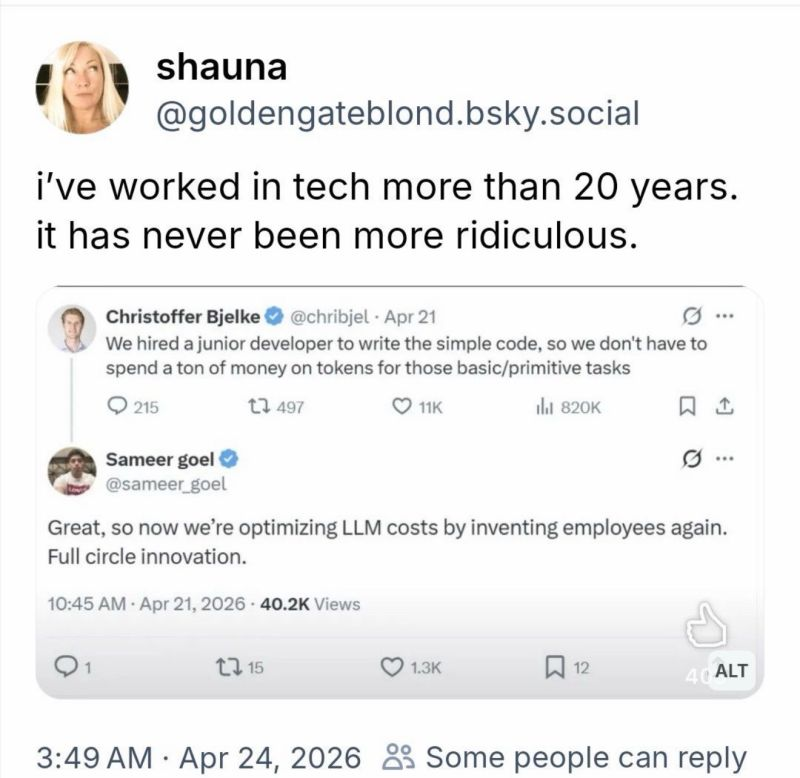
You might argue that if AI will genuinely replace significant engineering work in three years, restructuring now is rational planning. But that argument assumes there was slack in the system to begin with.
Product and engineering organizations have already been running a tight ship for years —the backlog was never empty.
What AI adds right now is more load; not relief. The learning curves, the governance questions, and the very real AI FOMO pressure that has teams feeling compelled to experiment with every new tool and model release just to avoid falling behind.
The small efficiency gains appearing in pockets are barely keeping pace with that added work. Cutting staff in that environment just adds more pressure to an already stressed system.
Compounded by market uncertainty and the economic ripple effects of a world that feels increasingly unstable, this is a recipe for organizational fragility—not resilience.
So, what do you do when all of this is making you uneasy, too?
Reality, composure, and a grounded sense of your own stance
What leadership needs right now is reality, composure, and a grounded sense of your own stance.
Yes, it matters to engage with AI, to use it, to stay informed. But it also matters to see what is actually there.
What are your customers really experiencing right now?
How can you realistically make their lives 5% better, their processes a little more efficient, their challenges a little smaller—concretely, next week or next month? Even if it’s without AI?
Leadership has never been well served by the headless chicken model.
By the way, if you want the practical side of navigating AI transformation—the traps to avoid, the patterns that slow progress—I've written about that here.
What this moment calls for is more like the rock in the surf: Change still has to be managed. Upskilling your people matters. Finding and protecting time for real conversations about what's being learned matters. Setting clear goals that help filter the noise matters, because how are we actually measuring whether the promised efficiency gains are materializing?
But what I see around me is not these calm leaders. I’m seeing more and more stressed people.
The work is shifting and growing more intense with LLM use. The product leaders and CPOs I coach tell me their people are completely fried before lunch —after a morning of generating content and reviewing outputs in Claude, Gemini, and ChatGPT, they're just done. Adapting to this new type of work doesn’t make them more productive because they’re out of energy and brainpower by noon.
So conversations about how we actually work—what a sustainable rhythm looks like for humans in this new setup—still needs to happen.
We’re building the future without a compass worth following
And beyond these operational questions, there's something bigger that I keep circling back to: We are collectively building the future without a compass worth following.
Here's what I mean: A significant part of the vision currently driving the AI industry is borrowed from science fiction— Black Mirror episodes and films like Her,the 2013 Spike Jonze movie in which a man falls in love with his AI assistant.
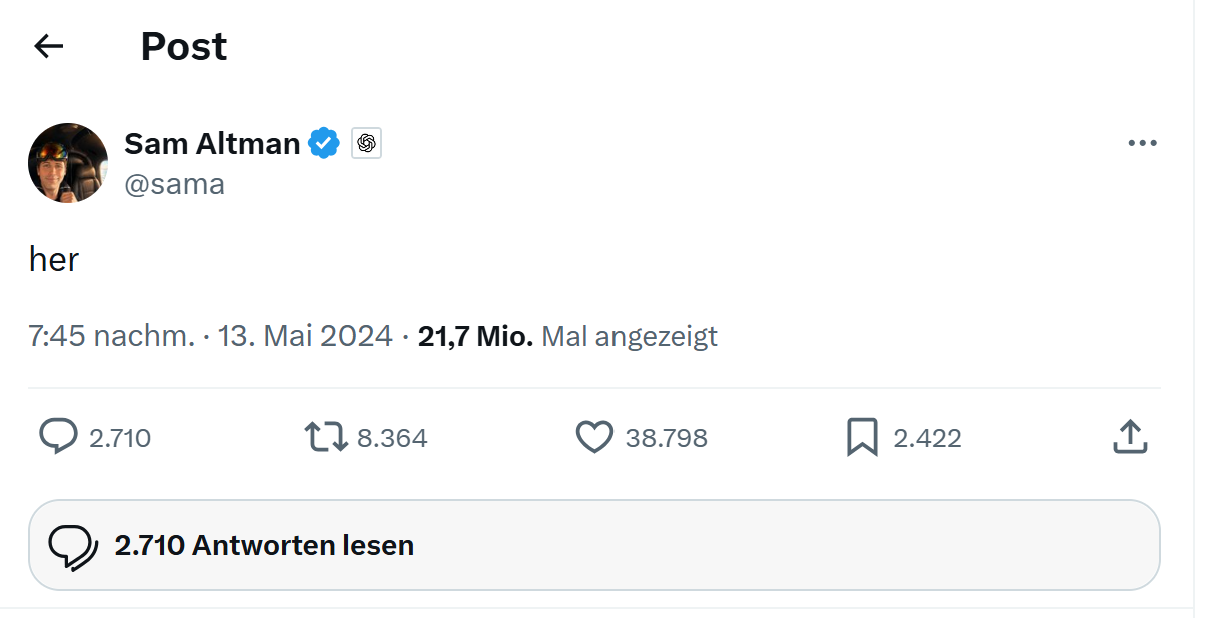
I’m not kidding about this. When Sam Altman unveiled a new voice interface for ChatGPT in May 2024, he posted a single word on X: "her." It got 21.7 million views. He meant it as a compliment. As a vision.
Screenwriters wrote those stories for dramatic effect. Not as product specifications. Not as a blueprint for the world we want to live in. Some of them were written explicitly as warnings.
And yet here we are, building toward them.
That's not a compass that we should be following. It's borrowed imagination. And some of the people who lent it to us would be horrified.
"The old world is dying, and the new world struggles to be born: now is the time of monsters." – Antonio Gramsci
How do we collectively ensure that the world of tomorrow is worth living in—for people, and for all living things in it?
Software companies have an outsized hand in shaping that answer. And product leaders have an outsized hand in shaping what software companies build.
That chain of responsibility runs directly to you. Which is exactly why it matters that these are still only scenarios. Nothing is determined yet. A completely different future can still emerge from this moment.
And for that, it's worth occasionally stepping back into real life—with a pen and a notebook —and thinking about where your own contribution to a positive narrative around AI actually lies.
By the way, I don't have a finished answer or a most likely scenario on all of that myself. It's still forming, like a mosaic, through conversations with my clients and coachees, my colleagues, the speakers at our conference, and my broader network.
What I do know is that technological progress has never been stopped. But it has always helped when people had ideas for a better world and were loud about them: workers' rights,social participation, Ralph Nader, who named what car manufacturers didn't want named and gave us seat belts and crash standards. There’s also the example of the scientists who helped build the most dangerous technology of the 20th century and then spent the rest of their careers loudly advocating for its control because they had made it, and they understood what that meant.
I've written before about curation as a form of resistance—small, intentional acts that push back against indifference. This is that same impulse, made more urgent.
Think back to Marcant's basketball coaches. They probably didn't think of themselves as political actors. They were just showing up and coaching. And yet what they modeled traveled all the way to where he is now, offering young people a different way to see the world. That chain of influence is long and often invisible.
So: Where is your positive narrative? And are you being loud enough about it?
If this resonated - my 52-week email course From STRONG to Exceptional covers this and 51 other product leadership topics, one week at a time. Have a look.