The PLwheel in Action: How Product Leaders at ING Netherlands are Defining Excellence
What makes a product leader “good” at their job? If you’re not sure how to answer that question, you’re not alone. After ten years of working with product leaders, I realized that it’s incredibly rare for companies to have consistent frameworks or rubrics that allow them to define what good product leadership looks like. Until now!
Based on my work with hundreds of product leaders and teams, I developed the PLwheel, a structured self-assessment and development tool exclusively for product leaders. If you’re interested in learning more about the origins of the PLwheel, you can find that here.
Today, I’m excited to share the first case study of the PLwheel in action with Jinto Jose, Product Area Lead, Data Management at ING Netherlands. You’ll hear how Jinto has used the PLwheel for his own self-assessment as well as how he imagines sharing it with other product leaders at his organization. And if Jinto’s story inspires you, explore all the ways to get access to the PLwheel here.
This interview was conducted and edited by my blog editor, Melissa Suzuno.

Tell us a little bit about yourself and your role.
I'm a product area lead within data management in ING Netherlands. It’s similar to a head of product role in other organizations. There are three parts to my role:
Delivery: I have to deliver data-related products to the internal customers of ING.
Building a high-performing team: My job is to make sure that the product managers in my product area of around 50 people do their jobs, build good products, and deliver as per ING’s strategy.
Continuous improvement: I also have to make sure that this high-performing team keeps improving, not just as a team, but in our products as well. While ING is an agile product organization when it comes to customer-facing products, we’re still in the process of adopting product thinking for our internal products and customers.
How did you find out about the PLwheel, and how did you decide that it was a tool that you wanted to try out?
Our company is going through a transformation process called “boosting agile,” and through that program, I had the opportunity to do coaching with Petra. She suggested that because I’m in a product leadership role, the PLwheel could be a helpful tool for supporting the product managers on my team.
I had read Petra's book, STRONG Product People, and it really resonated with me—especially the framework of product, process, and people. I wanted to see how I could help my peers to understand more about product thinking.
Because we’re a bank operating in Europe, there are a lot of regulations in place and we must be compliant. Therefore a lot of the things we do are dictated by these regulations. And because of these compliance processes, it can be difficult to make the paradigm shift toward product thinking. I knew that I needed something I could use to study myself and help my peers and something that could help me evaluate where I stand and where I can grow and help my product managers.
When Petra suggested I try out the PLwheel, I jumped at the opportunity.
What were you hoping to achieve with the PLwheel?
I’m really inspired by Marty Cagan’s works such as Empowered, especially when it comes to product leadership skills. Marty talks about product as an art and as a creative process.
But it really helps to have a tangible way of looking at things or a template that we can follow.
And what the PLwheel does is give you a framework so you can look at different areas of your product leadership work and role and assess whether you’re a beginner, somewhere in the middle, or at an expert level.
What I was hoping to achieve was to help my peers and myself to see the gaps, and to help my product managers to see if these are gaps that they can grow into.
Can you share any skill or competency gaps you’ve identified with the wheel or any org development ideas you got from it?
One was peer and executive alignment. It's generally easier to talk with the product managers about the product, but it can be difficult to get alignment between executives, so that was the first point where I tried to use it—communicating product direction to executives, strengthening cross-functional executive partnership.
Another one was directional clarity. Am I giving enough clarity to my colleagues and my product managers? Am I giving them enough direction? It’s helpful for me to think about how I’d answer these questions both for myself and for all my product managers.
I noticed that there were some points where I could understand my own gaps and others where I could understand the gaps in product managers. And now I have a clear and consistent way to give them feedback.
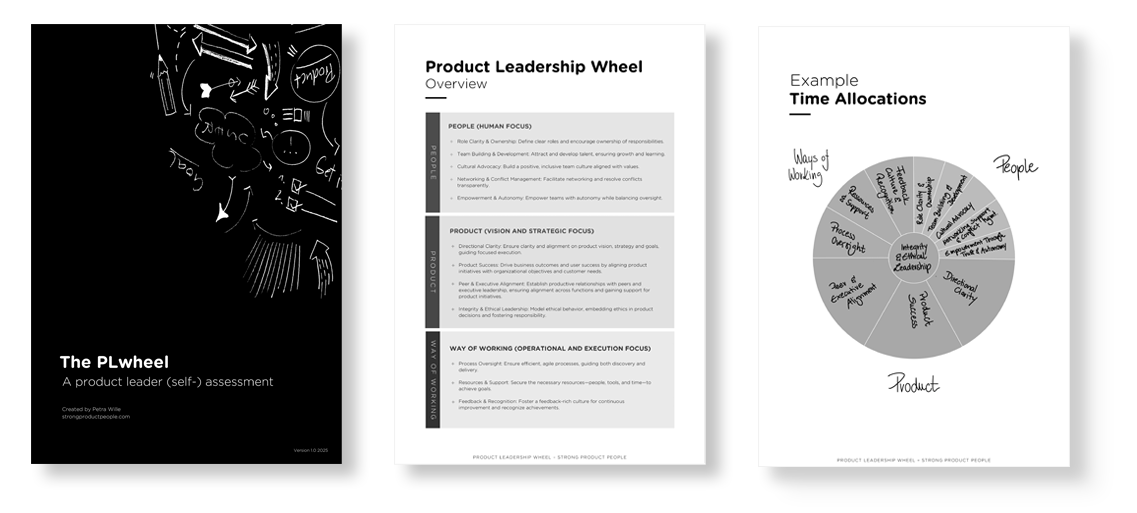
A selection of just a few pages from the PLwheel to give you a sense of what it looks like. For each slice of the wheel, product leaders have a set of prompts and questions to guide their self-assessment.
What’s next? Do you have any further plans for the PLwheel at your organization?
There's a group of heads of product within ING Netherlands and around five or six of us have come together to try to develop product craftsmanship within the organization. I’d love to bring this to them—since it’s a clear framework that’s already productized in a way we can use it within the organization.
I can see us starting with self-assessments and then to spark reflecting meetings with our peers. We might gather several managers together to discuss our strengths and areas to improve. And I could even see us giving it to the product managers as a way to give feedback to their leaders.
Who would you recommend work with this tool? Who do you think it would be most helpful for?
This is really for product leaders, the managers of product managers, the people who are responsible for shaping product managers. This is your toolkit to build a shipyard, as Petra says.
As far as the types of companies that would most benefit, I’d say any companies that are really thinking seriously about product and that have executive buy-in to jump into the product way of work.
Any final thoughts you’d like to share?
It's really worth investing the time, if you are serious about being a manager of product managers. As I mentioned earlier—the concepts are comparable to the ones shared in Empowered by Marty Cagan, but the PLwheel really fills in the gaps of what the head of product should be like.
Want to try the PLwheel for yourself? Explore all the ways to get access to the PLwheel here.
